At the age of 5–6, children can often count to 10, to 20, some children to 100. Many parents think that means their children are "good at math", or conversely worry because their children cannot do addition on paper. Actually, mental math at this age is not calculation yet. It's about the child understanding quantities, seeing the rules and knowing how to compare with their own hands and eyes.
This article suggests what to teach, 10 games to do at home with available items, how to know if your child really understands numbers, and common mistakes parents make.
What mental math should 5–6 year olds learn?
There are six core content groups. There is no need to teach in a rigid order, just touch a few groups each week through games.
Counting and understanding quantities
Children count real objects, each object counts one hour, and understand that the last number they read is "how many". Babies also begin to recognize small numbers (1 to 5) with just one look, without needing to count each one, just like looking at the face of a dice.
Comparing more, less, equal
At first, babies are often fooled by the arrangement: 5 candies lined up look "more" than 6 candies arranged close together. Have your child pair them one by one between two groups to help them see which group is left over.
Classify
Arrange objects by color, by shape, by size, then change the classification rules. This is the first step of logical thinking: the same group of items can be divided in many ways.
Rule
Color range "red, blue, red, blue, ?", shape range "round, square, square, round, square, square, ?". Children learn to see repetition and predict the next part. Later, this is the foundation for the number sequence in the upper layer.
Flat shapes and cubes
Name circles, squares, triangles, rectangles; distinguish between cubes, cylinders, and spheres by holding, rolling, overlapping.
Position and order
Top, bottom, front, back, inside, outside, left, right; first, second, third. For children, the "left side" is often the most difficult, so use a specific landmark such as "the side holding the spoon".
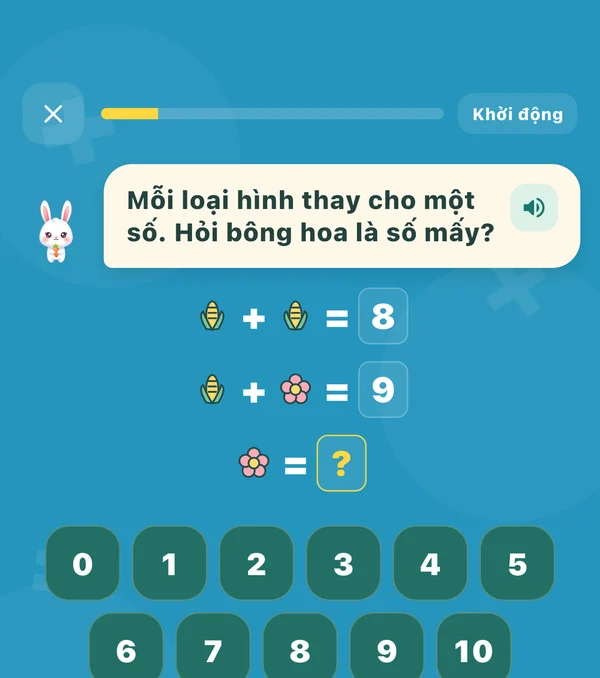
From about 6 years old, when the child has mastered the above, you can add a few light puzzles using small addition. For example, the lesson "pictures instead of numbers" in the photo below: two ears of corn add up to 8, so each ear of corn is 4; An ear of corn plus a flower equals 9, so the flower is 5.
10 mental math games at home with available items
Each game only requires 5–10 minutes and household items. Parents do not need to prepare anything elaborate.
1. Small supermarket
Display a few toys, label them with paper prices of 1, 2, 3 coins, give the baby 5 coins. The child chooses to buy what he has enough money for. Children practice: counting, small addition within 5.
2. Who has more?
Divide candy or grapes into two plates, ask which plate has more. Have your baby pair up one-on-one to check instead of just looking. Children practice: comparing more, less, equal.
3. Pack things in groups
Pour wooden blocks, crayons, and toy cars together, and ask your child to put them in each box. Then change the rules: sort by color. Children practice: classify by one characteristic, then change the characteristic.
4. Rule beads
String beads or arranging bottle caps according to the rule of red, green, red, blue. Mother arranges the first four, baby arranges the next. Children practice: recognizing and extending the rule.
5. Find pictures in the house
Go around the house looking for round objects (plates, clocks), squares (tiles), rectangles (doors, books). Kids practice: recognizing flat shapes in life.
6. Block builder
Using milk cartons, cans, balls: which ones can roll, which ones can stack on top of each other? Children practice: shapes: box, cylinder, sphere.
7. Where is the toy hiding?
Hide the teddy bear and say the hint: "under the table, to the left of the chair". Then change roles to let your child say the suggestion. Baby practices: upper, lower, front, back, left, right positions.
8. Line up stuffed animals
Line up 5 stuffed animals in a row. Question: What's the rabbit's position from the left? Which number is from the right? Baby practices: sequential numbers, counting from both sides.
9. Secret hand
Mom hides a few pebbles in both hands, opens one hand (for example 2 pebbles), says the total is 5. How many pebbles are there in the other hand? Kids practice: separating and combining numbers, the foundation of subtraction.
10. Cooking with mother
Count spoons of sugar, divide the cake among the whole family, compare which cup is fuller. Kids practice: counting, dividing evenly, comparing capacity.
Tip: After each game, ask your child a "why" question: "Why do you know this plate more?", "Why is the next bead red?". It's okay if your baby doesn't speak fluently yet. Practicing how to think is more important than the answer.
Signs your baby really understands numbers
Counting by heart does not mean understanding numbers. Some signs that the baby has really grasped:
- Knows the last number is "how many".After counting 7 candies, ask "how many candies?", the baby answers 7 immediately without counting from the beginning.
- Do not be fooled by the arrangement. Spread the 7 candies out evenly, the baby still knows it's 7, no need to count again.
- Take the correct amount requested. "Please help me get 6 spoons" and the baby stops at 6, doesn't take the whole handful.
- Can continue counting. There are 4 available, add 2, baby counts "5, 6" instead of counting from 1 again.
- Knows one more or less. Baby knows 6 is "one more than 5", and 4 is "one less than 5".
- Can separate numbers small. 5 pebbles can be 2 and 3, or 4 and 1.
If your baby doesn't have some of these signs yet, don't rush to let him do addition on paper. Returning to playing with real objects for a few more weeks will help your baby move faster in the future.
Common mistakes parents make
Teaching calculus too early
Children know "2 + 3 = 5" like a poem but cannot visualize 2 candies versus 3 candies. When asked to change the way of asking, the child could not do it. Always start with objects, then come to drawings, and finally come to numbers.
Help when your child is confused
Looking at your child struggling, it's easy for parents to say the answer. Instead, follow the steps: ask the problem again, suggest your child lay out the objects and count them, then model a small step.
Compare your child with you
At this age, a difference of a few months in age makes a big difference. "Bin can count to 100" only makes your child afraid of math.
Study too long
5–6 year old children concentrate well for about 10–15 minutes. Continuing to study when your child is tired can easily turn math into fear. Stop when your child is still having fun.
Only praise the right answer, criticize the wrong one
Praise the way your child tries ("You put them in a line to count, it's great") helps your child dare to try more than just praising the correct answer.
When is your child ready for grade 1 lessons?
When your child can count firmly within 20, compare and combine numbers up to 10, and see simple rules, he or she is ready for grade 1 problems such as number sequences, counting shapes, and simple queuing problems. Parents can read the lesson Common forms of mental math in elementary school to know what lies ahead, or let their children try TIMO grade 1 practice questions. An overview for all ages is available in mental math handbook for children.
Study with Thỏ Bông in the Karotto app
Transparency note: Karotto is app developed by the team behind this website. The games above do not require an app; The app is just an option for your child to practice more.
Karotto's "Number Garden" Math course has 504 lessons divided into 8 islands, of which the first islands are for 5-year-old children (Level 1 and Level 2), then gradually increase to 8 years old. Children count, compare, add, subtract and find rules with drawings to see and count. Before each new form, Thỏ Bông models a small number example with animation.
The most important point for children 5–6 years old: every problem has voice read out loud (in Vietnamese), so children who cannot read can still do it themselves. When stuck, the child presses the hint in 3 steps: light reminder, illustration, then answer with explanation. In the 5-year-old island, there is also a TIMO-style training session for grade 0 (kindergarten) with self-generated questions from the app. The App has no ads; Every day the child learns a certain amount of lessons for free, and when his turn ends, Thỏ Bông will see him tomorrow. Premium unlimited learning, buy once for lifetime use, no subscription required.
In short
Math thinking for children 5–6 years old is playing with real numbers: counting, comparing, classifying, finding rules, recognizing shapes and positions. Every day 10–15 minutes, objects first, numbers later, and always ask your child "why".
Frequently Asked Questions
Does a 5-year-old child who can count to 100 understand numbers?
Not sure. Reciting numbers is different from understanding quantities. Try displaying 7 candies, count them and ask "so how many are there?". If the child immediately answers 7 without counting again, and knows that 7 pieces arranged sparsely or closely are still 7, the child has truly understood the number.
How long does a 5–6 year old child learn mental math each day?
About 10–15 minutes, mainly through games with real objects. Can be divided into two short sessions during the day. Stopping while the child is still having fun is better than continuing until the child gets bored.
Should a 5-year-old child do homework?
Maybe, but it shouldn't be the main thing. At this age, babies learn best with their hands and eyes: holding, folding, counting objects. Worksheets or apps should come later, when your baby has become familiar with the idea with real objects.
What should you do if your baby often misses or doubles counts?
Let your baby touch or move each object to the side while counting, with one count for each object. Putting things in straight rows before counting also helps your child miss less. This is a very normal mistake at this age.
Let 5-6 year olds learn math on their own with Thỏ Bông
The topic has a Vietnamese voice, pictures to look at and count, Rabbit models it before the child does it themselves. Learn a reasonable amount of lessons every day for free.