"Thinking math" is a phrase parents hear a lot: at the center, online, in parent groups. But what actually is mental math? Is it different from the math your child learns at school? What age should a child learn and how to learn it appropriately?
This article is a summary for parents. Each section summarizes a big question, with specific examples and links to detailed lessons when parents want to dig deeper.
What is mental math?
Simply understood, mental math is a way of learning math that focuses on how to think and not just calculation. Children still use addition, subtraction, and comparison like in school, but the math problems are placed in situations that force them to observe, find rules, try a few possibilities, and then choose a solution.
Let's take an example. Math problems in school often ask: "What is 8 minus 4?". A thinking problem uses the same calculation but asks differently: "Two ears of corn added together equal 8, one ear of corn plus one flower equals 9. What number is the flower?". The child must realize that each ear of corn is 4, then find the flower that is 5. Calculation is not difficult, the difficult thing is that the child must find the way.
How is mental math different from calculation?
- Calculation math trains speed and accuracy: mental math, multiplication tables, placing count. It is very necessary, and is the foundation.
- Thinking Mathematics practice the approach: read the problem carefully, recognize the problem type, draw a diagram, try and check again. A problem may only require addition, but it takes your child a few minutes to think.
The two things are not mutually exclusive. Children who calculate slowly will be tired when solving thinking problems, while children who calculate quickly and are not used to reasoning will be confused when the problem is a little different. Additional note: "mental math" is not the name of a single method. Many centers and methods (abacus, Singapore, Montessori...) all use this word in their own way. The article Review of mental math learning methods compares those directions in detail.
What does learning mental math bring to children?
Parents should have realistic expectations. Mental math does not turn your child into a genius, but if learning is fun and regular, your child will often have a few good habits:
- Read carefully before doing.Many exercises intentionally have details that are easy to miss, so children will learn how to re-read the problem.
- Not afraid of unfamiliar lessons. Children are familiar with the feeling of "not knowing what to do" and know how to start by trying a small case.
- Knows how to draw to think.Line diagrams, drawings, and displaying objects are tools that children can use throughout the following school years.
- Patience and self-testing. Once the answer is found, the child tries to replace it with the question to see if it is correct.
These habits are also what the child uses when learning programming or playing chess. The article 5 ways to help your child improve their thinking has more suggestions outside of math.
Math thinking for each age
Each child has a rhythm, so the milestones below are for parents to visualize, not mandatory standards.
Common forms of mental math
Even though books or exam questions have different names, most elementary thinking math problems fall into several familiar groups:
- Rules: series of numbers, series of letters, series of shapes. For example, the letter sequence E, X, F, W, G, ? there are two alternating sequences: E, F, G go forward and dozen.
- Counting images:Count overlapping triangles and squares.
- Quick calculation:Pairing, grouping round numbers by ten.
- The problem has typical text: age, lining up, chickens and dogs, planting trees.
- Logical inference: who is tallest, who sits where, how many children are there in the family.
- Words numbers and combinations: Make up numbers from cards, count numbers that satisfy conditions, count ways to choose.
Lesson Common forms of thinking math in elementary school goes through each form with recognition signs, ways of thinking and an example with solution.
How long is enough to study at home every day?
Short and consistent is more important than long. Suggested duration:
- 5–6 years old: 10–15 minutes, mostly object play.
- 7–8 years old: 15–20 minutes, about 3–5 lessons, with one moderately difficult lesson right.
- 9–10 years old: 20–30 minutes, can solve a long problem and then explain how to do it.
A good session usually has three parts: starting with an easy problem so the child can see he can do it, one or two problems that require thinking, and ending with the child telling "how he did it". The last part sounds simple, but it helps your child remember how to think much longer than just remembering the answer.
Tip when your child is stuck: don't solve it for you right away. Please suggest in steps: first ask "What is the question asking?", then suggest "Try to draw it", and finally model one step. Children who can take the last step themselves will remember it much better.
Should your child practice for the Math Olympiad (TIMO…)?
Exams like TIMO, with questions divided into logic, arithmetic, number theory, geometry and combinatorics, can be a fun goal for children who like to solve puzzles. Exams help children get used to time pressure and new types of problems.
The downside is that it can easily turn into random learning: practicing memorization, memorizing tips, without really understanding. Questions to test yourself: do you want to take the test, are you happy or tired after each practice session, and can you explain the solution. Article What is TIMO? What parents need to know before letting their children take the exam clearly state the exam structure, exam rounds, how to register and risks. If you want your child to try first, you can use practice questions with solutions: grade 1, grade 2, grade 3.
How to choose mental math apps and materials?
Books, worksheets, centers or apps can all be used, the important thing is that they are suitable for your child. Some criteria to filter:
- Does it go from easy to difficult?Good materials start with small number examples and then increase difficulty.
- Are there explanations or just answers?Answers do not teach how to think.
- Can small children use it themselves? With the app: is there a voice reading the questions, are the buttons loud and clear.
- Are there any ads or buy buttons that are easy to press by mistake?
- Are the questions copied from the real test? Many documents copied from exam questions are copyrighted. Priority should be given to clear sources.
Karotto "Number Garden": our mental math course
Transparency note: Karotto is an app developed by the team behind this website. All the advice above applies to books, pen and paper or any other tool.
Karotto is a thinking app for children 5–11 years old on iPhone, iPad and Android, including four subjects: Programming, Math, Chess and Cube. The Math course is called "Number Garden", with 504 lessons divided into 8 islands (M1 to M8): each age group from 5 to 8 has Level 1 and Level 2. The content ranges from counting, comparing, adding and subtracting to finding rules and math problems with text and pictures for children to see and count.
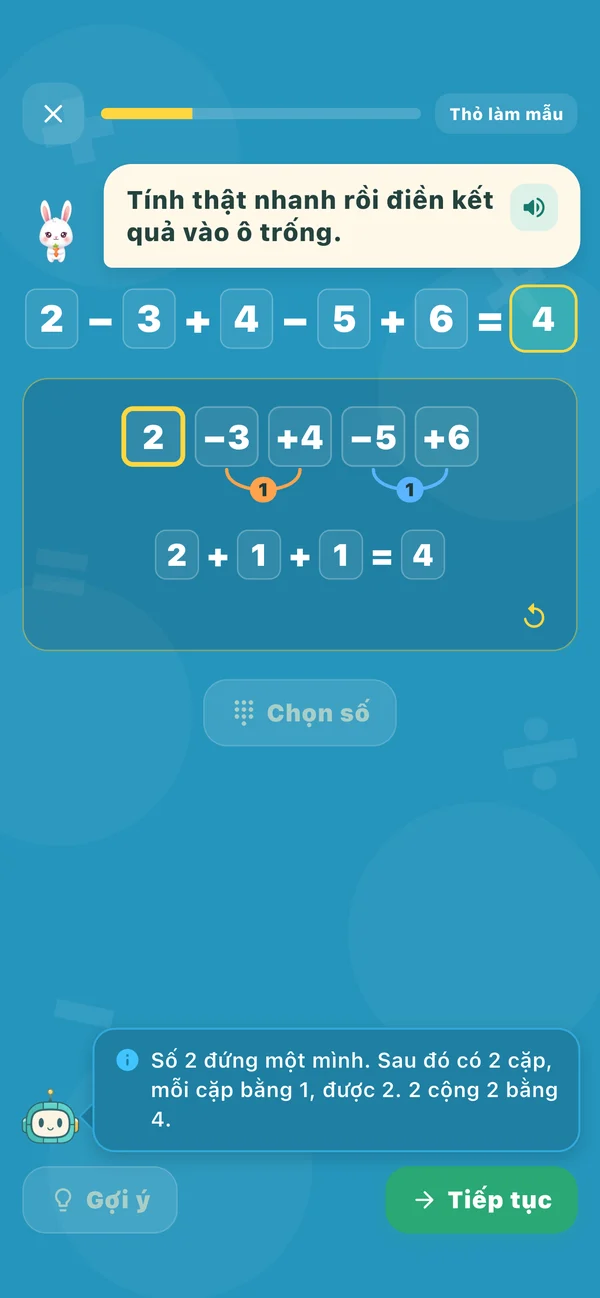
Before each new form, there is a step "Rabbit as model": Thỏ Bông solves a small numerical example with animation, then the child does it himself. The photo below is a quick calculation of 2 − 3 + 4 − 5 + 6: the app pairs −3 with +4 and −5 with +6 into two pairs, each pair equals 1, so the result is 2 + 1 + 1 = 4.
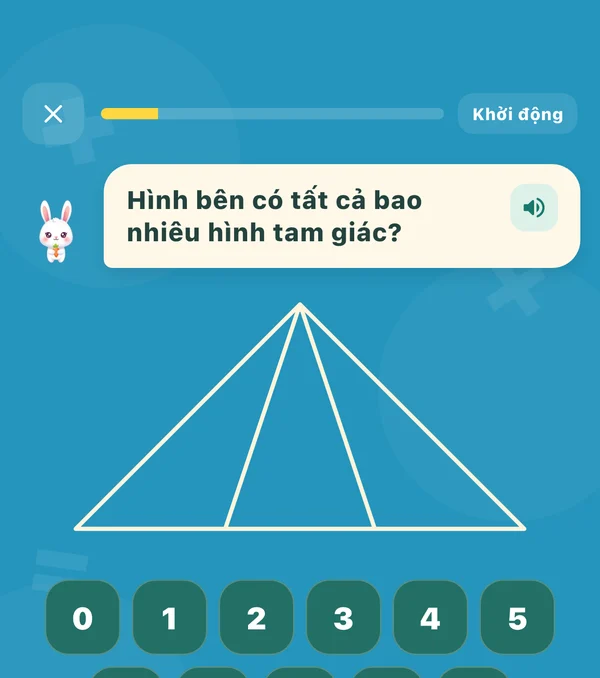
When your baby is stuck, suggest following 3 steps: gentle reminder, then illustration, finally the answer with explanation. All problems and solutions have voice read out loud (13 languages, including Vietnamese), so children who are not fluent in reading can still learn on their own.
In between stages are often stages style practice TIMO follows 5 areas of logic, arithmetic, number theory, geometry and combinatorics: grade 0 (kindergarten) in 5-year-old islands, grades 1, 2, 3 in islands M4, M6, M8. At the end of the island, there is a Practice test exam format: timed, graded in each area and let your child review the wrong sentences. Tests are generated by the app itself, do not copy real exam questions, and Karotto is not affiliated with any exam organizers.
The app has no ads. Every day, children can learn a reasonable amount of lessons for free, all islands are open. Premium offers unlimited lessons every day, is a one-time purchase for lifetime use, not a monthly subscription. In short, mental math is learning to think based on familiar calculations. Start with games when your child is 5–6 years old, gradually increase to lessons with text, learn briefly each day, give step-by-step suggestions instead of solving them, and consider exams as testing opportunities, not destinations.Buy once, use for life, not a monthly subscription.
In short
Mental math is learning to think based on familiar calculations. Start with games when your child is 5–6 years old, gradually increase to lessons with text, short lessons each day, step-by-step suggestions instead of solutions, and consider exams as testing opportunities, not destinations.
Frequently Asked Questions
How is mental math different from math at school?
Math at school The school focuses on knowledge and skills calculated according to the program. Mental math uses the same knowledge but puts it in more strange situations, forcing children to observe, find rules, try and reason before calculating. The two things complement each other, not replace each other.
At what age can a child start learning mental math?
5-6 year old children can already get acquainted through games of counting, comparing more or less, classifying objects and finding color rules. Math problems with text and forms like chicken and dog, planting trees are more suitable for children in grades 2–3 and above.
How long should children study mental math each day?
For children 5–8 years old, about 15–20 minutes a day is enough, divided into a few short lessons. Children 9–10 years old can sit for 25–30 minutes. Studying regularly every day is more effective than one long session on the weekend.
Should your child practice for the Math Olympiad like TIMO?
The exam should be considered an opportunity for your child to try, not the main goal. If your child likes solving puzzles and wants to take exams, moderate practice is very helpful. If your child is forced to learn formulas or is afraid of math, he should stop.
Can parents who are not good at math teach their children mental math?
Okay. Most lessons for elementary school children only require simple addition, subtraction, multiplication and division. The important thing for parents is to ask their children how they are thinking, encourage them to draw pictures or display objects to try, and not solve them for you too early.
Learn mental math with Thỏ Bông
504 math problems from counting numbers to lessons with text, with Rabbit steps as a model, 3-step suggestions and Vietnamese voice. Learn a reasonable amount of lessons every day for free.